
A comparison of rollstock vertical packaging and premade pouch filling systems.
You have chosen the packaging you want: perhaps a resealable stand-up pouch for coffee, a back-seal bag for rice, or a compact pillow bag for snacks. The next question is practical: which packaging machine can run it reliably?
A bag’s appearance does not tell the whole story. Two packages may look similar on a shelf but require different forming, opening, filling, and sealing equipment.
The starting point is simple: a vertical form fill seal machine makes bags from rollstock, while a premade pouch packaging machine fills and seals bags manufactured beforehand.
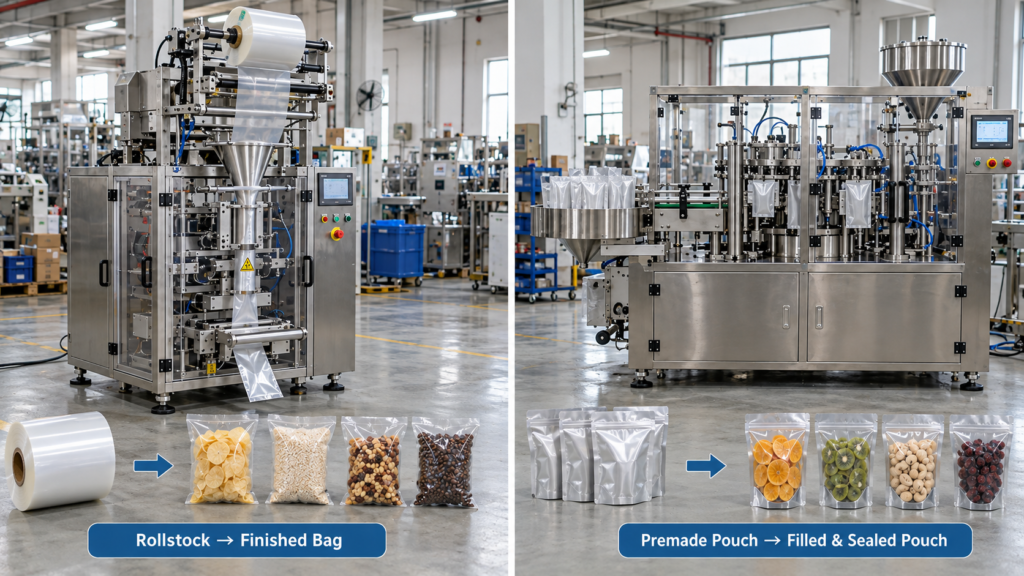
This guide explains how that difference affects bag compatibility, equipment selection, and your production costs.
What Is the Difference Between VFFS and Premade Pouch Packaging Machines?
VFFS Machines: Form, Fill, and Seal from Rollstock
A vertical form fill seal machine, commonly called a VFFS machine, converts a continuous roll of packaging film into individual filled bags.
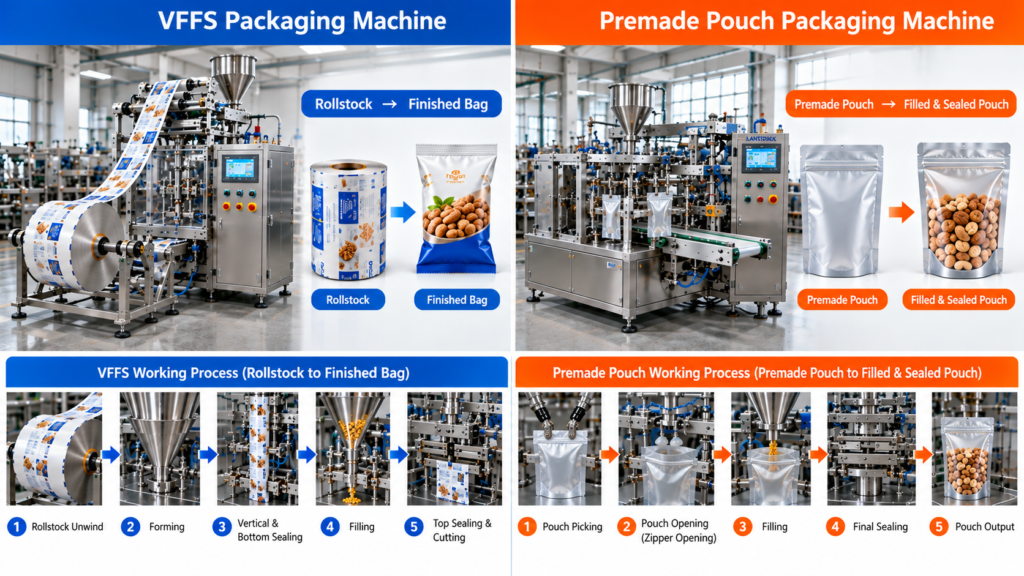
The basic sequence is:
- Unwind the packaging film.
- Guide it over a forming collar and around a filling tube.
- Create the longitudinal seam and bottom seal.
- Dispense the product.
- Complete the top seal and separate the finished package.
Because the machine creates the bag, its forming and sealing assemblies determine which constructions it can produce.
For conventional pillow bags, start by exploring LANTUPACK’s vertical form fill seal packaging machines. More complex bag structures require confirmation of the appropriate configuration.
Premade Pouch Machines: Open, Fill, and Seal Existing Bags
A premade pouch packaging machine receives finished, empty bags from a pouch supplier.
It feeds and grips each bag, opens the mouth, fills the product, and seals the remaining opening. The pouch manufacturer has already created the bottom, side seams, and integrated features.
For projects based on purchased pouches, LANTUPACK’s rotary premade pouch packaging equipment provides a relevant starting point for evaluation.
The selection question is whether the equipment can reliably feed, open, fill, and seal your exact pouch—not simply whether the pouch fits its nominal dimensions.
Which Bag Types Can Each Machine Handle?
Left to right: a back-seal pillow bag, a stand-up pouch, and an open zipper pouch.
Three common packaging terms describe different features:
- Stand-up describes the package’s ability to stand upright.
- Zipper describes a reclosable opening.
- Back-seal describes the location of a longitudinal seam.
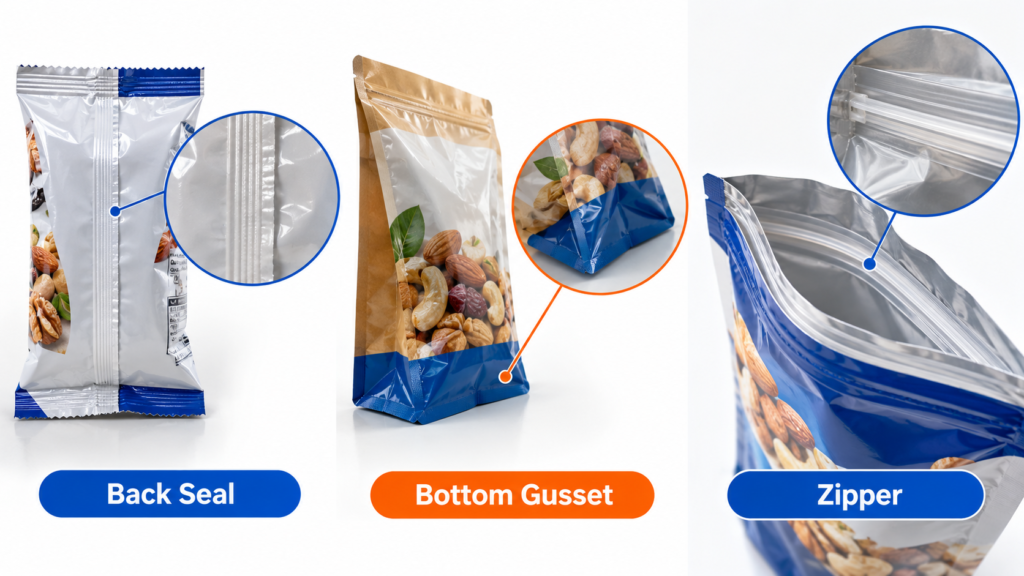
A package may combine these features. This is why a bag drawing is more useful for equipment selection than a general bag name.
| Bag construction | VFFS machine | Premade pouch packaging machine |
|---|---|---|
| Back-seal pillow bag | Typical application | Premade versions require handling confirmation |
| Side-gusseted bag | Requires suitable gusset-forming equipment | Requires compatible feeding and opening equipment |
| Block-bottom bag | Available on selected configurations | Requires suitable pouch handling |
| Quad-seal bag | Requires dedicated forming and sealing assemblies | Requires model-specific validation |
| Bottom-gusset stand-up pouch | Requires a specialized compatible system | Common application for suitable models |
| Zipper pouch | Requires compatible zipper integration equipment | Requires zipper-opening and suitable sealing equipment |
| Spouted or shaped pouch | Requires specialized assessment | Requires specialized assessment |
Treat this table as an initial screening guide. It does not mean every machine in either category supports every listed format.
Back-Seal Bags: A Typical Application for VFFS Machines
Back-seal bags have a longitudinal seam on the rear panel and seals across the ends. Pillow bags are a familiar example.
If your project involves snacks, grains, or granules in this construction, a rollstock vertical packaging machine is usually the first system to evaluate.
What Determines Back-Seal Bag Compatibility?
Check these details before approving a machine:
- Seal construction: Does the film require a fin seal, or can it support a lap seal?
- Bag capacity: Can the target product volume fit while leaving sufficient sealing clearance?
- Film behavior: Will the material track and form consistently?
- Artwork layout: Will the rear seam interfere with graphics or required text?
- Seal cleanliness: Can product dust or fragments enter the sealing area?
Do not select equipment based on fill weight alone. Products with the same weight can occupy very different volumes, affecting bag dimensions and filling clearance.
Can a VFFS Machine Make Stand-Up Pouches?
Yes, selected specialized VFFS systems can produce stand-up formats. However, ordinary pillow-bag capability does not establish compatibility with a particular stand-up pouch.
Identify the Exact Bottom Structure
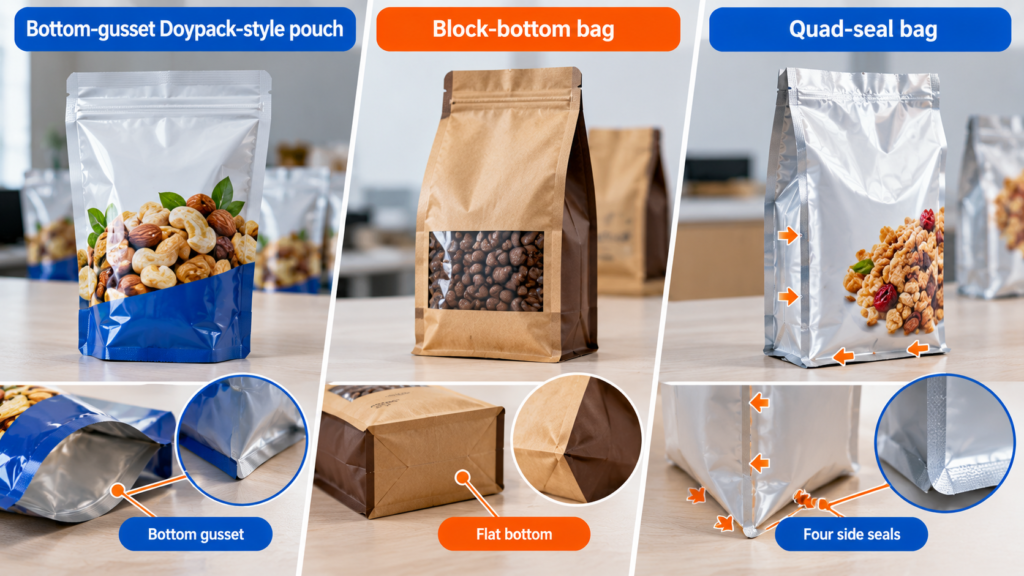
Several constructions can provide upright presentation:
- Bottom-gusset Doypack-style pouches.
- Block-bottom bags.
- Quad-seal bags.
Their folds, seam layouts, and forming requirements differ. A supplier’s statement that a machine makes “standing bags” needs to be supported by a construction drawing and sample production.
For a LANTUPACK project, submit your target pouch structure for assessment before assuming a standard VFFS configuration can produce it.
Test Standing Performance with the Actual Product
An empty sample may look suitable but behave differently after filling.
Evaluate:
- Whether the base opens and forms correctly.
- Whether the filled package stands consistently.
- Whether the product settles unevenly.
- Whether the bag tips during normal handling.
- Whether the finished appearance matches your retail requirements.
Material stiffness, bottom dimensions, fill volume, and product distribution all influence the result.
Can Both Machine Types Handle Zipper Bags?
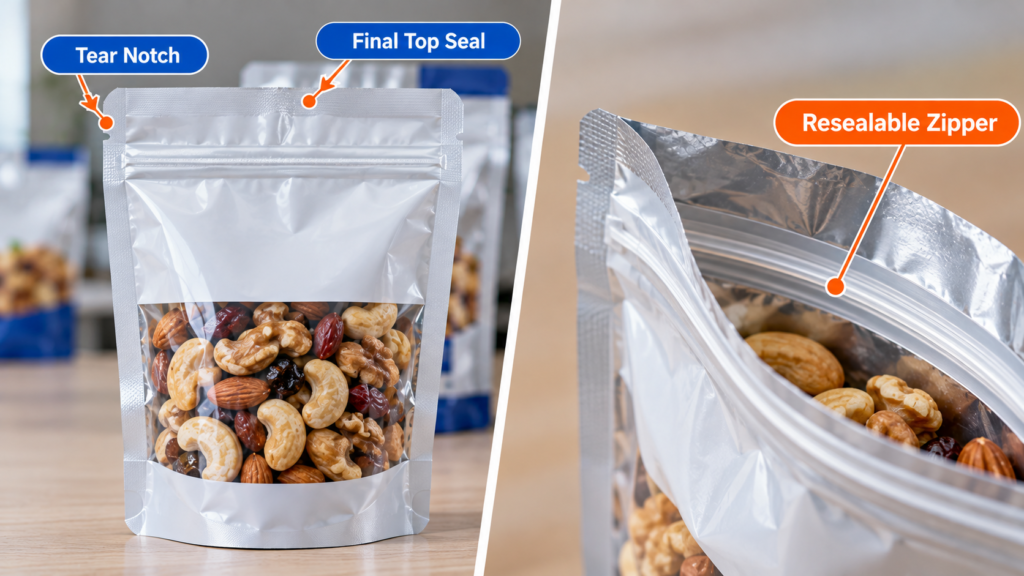
A zipper pouch after removal of the top strip.
Yes, but the two systems perform different tasks.
Zipper Bags on a VFFS Machine
A compatible VFFS system needs equipment to introduce, position, and attach the zipper during bag production.
Ask the supplier to confirm:
- Supported zipper orientation and profile.
- Zipper-feeding and sealing arrangements.
- Compatibility with the packaging film.
- Required forming and sealing assemblies.
- Production speed for the complete configuration.
A standard pillow-bag machine should not be assumed to support zipper bags through a simple control-panel adjustment.
Zipper Bags on a Premade Pouch Machine
With premade pouches, the zipper is installed during bag manufacturing. The packaging machine must open it sufficiently for filling and complete the specified final seal.
Check:
- Reliable zipper opening across representative pouch batches.
- Clearance between the zipper and filling nozzle.
- Product residue near the closure.
- Available sealing space above the zipper.
- Reclosure performance after filling and sealing.
A zipper provides reclosability; the complete pouch and final seal determine initial package integrity.
When Should You Choose Each Packaging System?
Start with VFFS for a Proven Rollstock Format
Evaluate a VFFS packaging machine when your priority is a conventional pillow bag or another construction that the proposed machine can demonstrably form from rollstock.
For repeated production runs, assess material costs, accepted output, and the work needed to change bag sizes or formats.
Rollstock can offer a material-cost advantage, but the actual difference should come from supplier quotations and production trials.
Start with Premade Pouches for a Defined Retail Package
Evaluate a premade pouch packaging machine when you have selected a specific pouch structure, such as a bottom-gusset zipper pouch.
This approach allows the pouch converter to manufacture the package structure before it reaches your filling line.
However, two pouches with identical width and height may still behave differently because of their stiffness, surface finish, gusset depth, or zipper position.
Before ordering printed bags in volume, verify them on the intended equipment.
Match the Filling System to Your Product
Bag compatibility is only one part of the packaging line. The dosing system must also suit the product.
Depending on the application, equipment to evaluate may include:
- Multihead weighers for suitable discrete products.
- Auger fillers for suitable powders.
- Pump or piston-based fillers for compatible liquids and pastes.
Final selection depends on flow characteristics, bulk density, particle size, viscosity, target weight, and accuracy requirements.
LANTUPACK’s equipment range includes filling and dosing systems alongside VFFS and premade pouch equipment, allowing these parts of the application to be considered together.
How to Compare Packaging Costs Fairly
The lowest equipment price does not necessarily produce the lowest packaging cost.
Compare cost per accepted, saleable package, including:
- Rollstock or empty-pouch purchase cost.
- Startup waste and rejected packs.
- Product giveaway.
- Actual accepted output per shift.
- Operator requirements.
- Cleaning and changeover time.
- Format parts, maintenance, and consumables.
Use the same product, bag dimensions, fill weight, and acceptance criteria when comparing proposals.
A maximum advertised speed is useful for initial screening. A sustained trial with your product and packaging material provides a stronger basis for production planning.
What to Send LANTUPACK Before Requesting a Quote
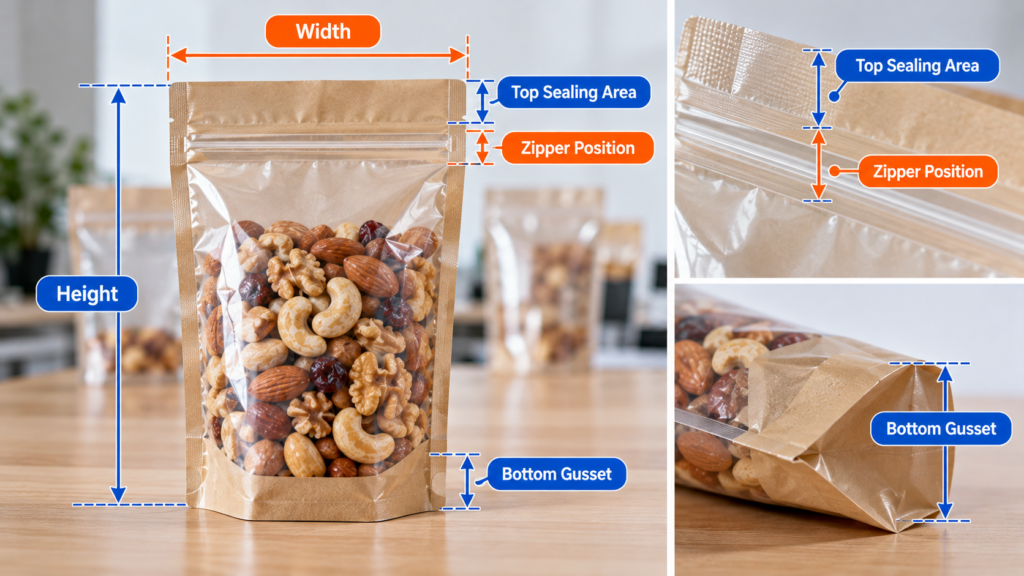
A clear specification makes it easier to recommend the appropriate configuration.
Prepare:
- Bag drawing or sample: Width, height, gusset dimensions, seams, and zipper position.
- Material details: Film structure, thickness, and available sealing specifications.
- Product information: Samples and relevant handling characteristics.
- Fill requirements: Target weight, acceptable variation, and headspace.
- Output target: Required accepted bags per minute and operating schedule.
- SKU range: Products, package sizes, and planned changeovers.
- Additional functions: Gas flushing, coding, tear notches, valves, or hanging holes.
- Cleaning requirements: Product changes and intended cleaning methods.
For VFFS trials, provide representative rollstock. For premade pouch trials, provide production-representative empty bags.
Verify the Finished Package Before Buying
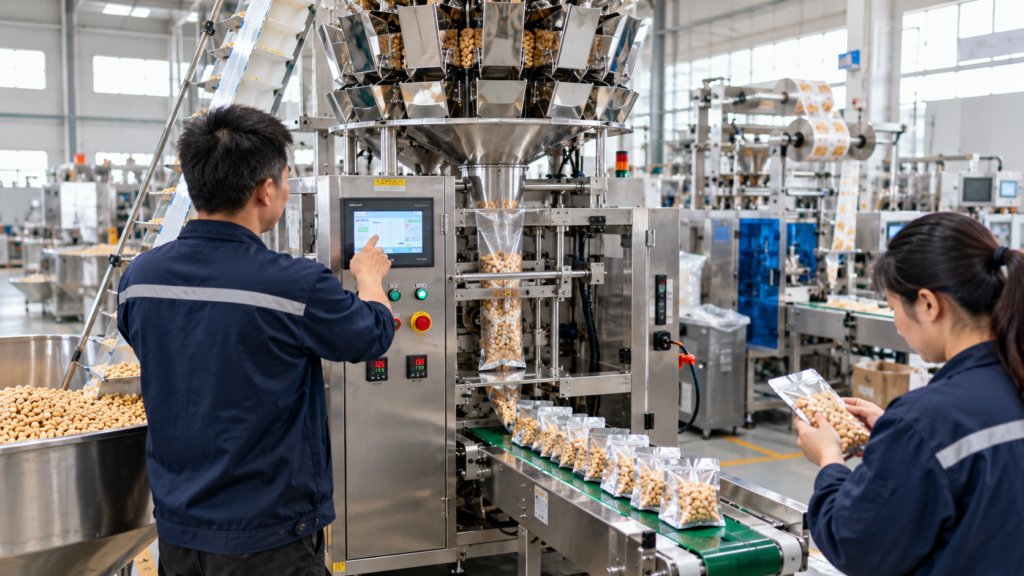
Agree on trial acceptance criteria before the demonstration.
Evaluate sustained accepted output, fill accuracy, seal quality, opening failures, reject rate, and changeover time.
For stand-up pouches, check stability and appearance after filling and representative handling. For zipper pouches, check reclosure after opening the final top seal.
If shelf life is critical, establish appropriate package-integrity and product-validation procedures. An attractive seal alone does not establish shelf life.
Frequently Asked Questions
Can One Machine Make Pillow Bags, Stand-Up Pouches, and Zipper Bags?
Some specialized platforms support multiple constructions with the necessary assemblies. Confirm every intended format in the written equipment specification and through sample production.
Does a Premade Pouch Machine Manufacture Empty Bags?
No. It fills and seals bags supplied in preformed condition.
Can an Existing VFFS Machine Be Upgraded for Zipper Stand-Up Pouches?
Possibly. Feasibility depends on the mechanical design, controls, installation space, and compatible forming and closure equipment. Obtain a manufacturer assessment before purchasing accessories.
Is a Quad-Seal Bag the Same as a Doypack-Style Pouch?
No. They have different constructions. Both may provide upright presentation, but their bottom geometry, seam layout, and production requirements differ.
Which Machine Should I Evaluate First?
For a conventional back-seal pillow bag, start with VFFS. For a specified premade bottom-gusset zipper pouch, start with a compatible premade pouch filler. For a stand-up zipper format made from rollstock, request a specialized VFFS assessment.
Find the Right Packaging Configuration with LANTUPACK
The right equipment starts with your actual bag, product, and output requirements.
Contact LANTUPACK with your pouch drawing or photos, product details, target fill weight, and required production speed. These details help the team assess a suitable VFFS or premade pouch packaging configuration and prepare a relevant quotation.